Stay up to date on tariff news with JORI’s Advisory Notices.
Feb. 28: Donald Trump to impose tariffs
Mar 12: Tariff’s on iron and steel
Mar 6th: CUSMA/USMCA Amendment
Mar 4: Tariffs on Canadian imports
June 2, 2025
Upcoming U.S. Steel tariff increase poses significant challenges for Canadian supply chains
On May 30, 2025, U.S. President Donald Trump announced plans to double tariffs on imported steel and aluminum from 25% to 50%, effective June 4. This decision aims to bolster domestic metal production and follows accusations that China violated a prior trade agreement.
Learn more: https://financialpost.com/commodities/trump-steel-tariff-hike-threatens-mass-disruption
May 26, 2025
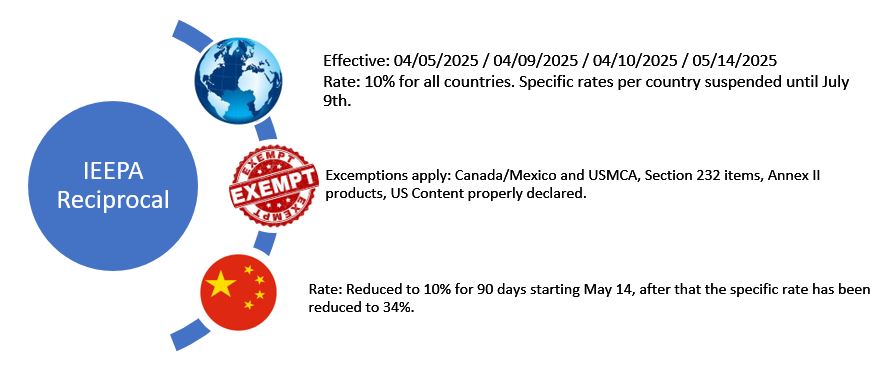
In general, Executive Orders and Proclamations have imposed new tariffs on goods imported into the United States pursuant to the International Emergency Economic Powers Act (IEEPA) and Section 232 of the Trade Expansion Act of 1962. Each set of tariffs should be treated separately as their applicability, scope and exemptions differ one from the other.
International Emergency Economic Powers Act (IEEPA) Tariffs.

Section 232 of the Trade Expansion Act of 1962

Unstacking Principle:
- Products subject to Auto/Auto Parts 232 will not be subject to MX IEEPA, CA IEEPA, Aluminum/Steel 232
- Products subject to MX IEEPA or CA IEEPA will not be subject to Aluminum/Steel 232
- Products subject to Aluminum 232 will be continuing to be subject to Steel 232 and vice versa.
- Exemptions Apply.
Links:
Section 232:
IEEPA:
Stacking:
Apr 4, 2025
The current tariff situation continues to evolve rapidly. We strive to provide accurate and timely updates. Please contact us directly for detailed inquiries regarding specific HS codes or product classifications.
| Imposed By | Imposed On | Date | Tariff | Amount |
|---|---|---|---|---|
|
Canada |
United States |
March 4 |
Retaliatory on $30-billion worth of U.S. goods |
25% |
|
United States |
Canada |
March 6 |
Non-CUSMA goods (Excl. energy, potash) |
25% |
|
United States |
Canada |
March 6 |
Energy products not covered by CUSMA |
10% |
|
United States |
Canada |
March 6 |
Potash products not covered by CUSMA
|
10% |
|
United States |
Canada |
March 12 |
Steel and aluminum
|
25% |
|
Canada |
United States |
March 13 |
Second Retaliatory Tariff on $29.8-billion worth of goods |
25% |
|
United States |
Global (excluding Canada and Mexico) |
April 2 |
Universal tariff on nearly all U.S. imports
|
Min 10% |
|
Canada |
United States |
April 3 |
Additional countermeasures (e.g., autos non-compliant with USMCA) |
25% |
March 20, 2025
The current tariff situation is currently fluid. While we try to ensure this information is all accurate please contact us for specific questions about specific HST codes or goods
| Imposed By | Imposed On | Date | Tariff | Amount |
|---|---|---|---|---|
|
Canada |
United States |
March 4 |
Retaliatory on $30-billion worth of U.S. goods |
25% |
|
United States |
Canada |
March 6 |
Non-CUSMA goods (Excl. energy, potash) |
25% |
|
United States |
Canada |
March 6 |
Energy products not covered by CUSMA |
10% |
|
United States |
Canada |
March 6 |
Potash products not covered by CUSMA
|
10% |
|
United States |
Canada |
March 12 |
Steel and aluminum
|
25% |
|
Canada |
United States |
March 13 |
Second Retaliatory Tariff on $29.8-billion worth of goods |
25% |
March 6, 2025
On March 6, 2025, the U.S. government issued an Executive Order modifying duties initially set by Executive Order 14194.
This recent amendment specifically pertains to goods entered duty-free under the Harmonized Tariff Schedule of the United States (HTSUS) according to the terms of the Canada-United States-Mexico Agreement (CUSMA/USMCA).
Key Details – Effective March 7, 2025
CUSMA/USMCA Duty-Free Articles
Goods entering the United States duty-free from Canada under General Note 11 of the HTSUS (including provisions in subchapter XXIII of chapter 98 and subchapter XXII of chapter 99) will NOT be subject to the additional ad valorem duty rate previously established in Executive Order 14194.
Importance of Accurate CUSMA/USMCA Certificates
Ensuring accurate and complete CUSMA/USMCA certifications remains critical. Proper documentation is required for eligibility verification and to avoid unnecessary duty payments.
Continued Tariffs on Steel and Aluminum
Please note that existing U.S. tariffs on steel and aluminum imports—as well as the removal of exemptions granted to Canada and Mexico starting March 12—remain unchanged by this Executive Order.
👉 Executive Order: Adjusting Imports of Steel into the United States
Status Of Canadian Retaliatory Tariffs
Canada’s initial retaliatory tariffs remain in effect despite recent postponements of some U.S. tariffs. Canada’s initial response tariffs, totalling approximately CAD $30 billion (USD $21 billion), apply to American goods such as orange juice, peanut butter, coffee, appliances, footwear, cosmetics, motorcycles, and certain pulp and paper products. Canada has stated it does not plan to impose additional retaliatory tariffs related to this specific U.S. Executive Order amendment.
Anticipated Increase in CBP Audits
Given potential tariff exemptions, increased audit activity by U.S. Customs and Border Protection (CBP) is anticipated. Companies must be prepared to produce relevant supporting documentation within 30 days of audit initiation. Failure to adequately document claims may result in retroactive duty assessments and additional penalties.
On February 4, 2025, U.S. President Donald Trump originally planned to implement a 25% tariff on most Canadian imports, with a 10% tariff on energy products. However, following high-level discussions between both governments and the inputs from trading partners, the enforcement of these tariffs was delayed for 30 days to allow for further negotiations. This delay has shifted the implementation date to March 4, 2025, unless a resolution or another delay occurs. As businesses prepare for this new tariff environment, understanding the scope of the tariffs and how they will affect different sectors is essential.
This new round of tariffs promises significant disruptions across a wide range of industries, from automotive and energy to consumer goods and agriculture. Given the deeply interconnected economies of both nations, these tariffs could increase costs, alter trade flows, and challenge established business practices. In this post, we’ll outline the details of these tariffs, the industries most affected, and how JORI Logistics can help businesses navigate the challenges and mitigate risks.
Overview of the U.S.-Canada Tariffs
The new tariffs imposed by the U.S. target Canadian goods across multiple sectors. President Trump is using the International Emergency Economic Powers Act (IEEPA) as the basis for the tariff orders. Here is a breakdown of the key aspects:
Tariffs on Canadian Goods:
A proposed 25% tariff is levied on a wide range of products, including automotive parts, finished vehicles, metals, agricultural goods, and consumer products. A proposed 10% tariff applies specifically to energy products like oil, natural gas, and electricity.
Impact on Businesses:
The tariffs will raise costs for U.S. businesses that rely on Canadian imports, resulting in higher production costs and possible price hikes for consumers. The tariffs will also likely disrupt established supply chains, as companies adjust to the new rules and seek alternative sourcing options.
Potential for Adjustment or Early Termination
It’s uncertain – as of now, the tariffs are open-ended. The 30-day delay was a one-time concession to encourage trade negotiations. That date has been pushed back again until April 2nd.
If the U.S. is satisfied that Canada has taken sufficient steps (especially on the issues cited as the reason for tariffs, such as border security and drug interdiction), the U.S. President could suspend or remove the tariffs. Conversely, if the escalating trade war continues, the tariffs could remain in place for a long period (potentially until the 2026 USMCA talks) or even increase. There is no fixed “sunset date.” In fact, the executive order explicitly reserves the right for the President to “increase or expand” the tariffs if Canada retaliates or if the situation worsens
On the other hand, positive diplomatic progress could lead to lifting the tariffs. Businesses should stay alert for updates. JORI will keep clients informed through advisories – if there are signs of an early resolution or any change in tariff rates, we’ll relay that information immediately.
Impact On Business
These tariffs will have wide-ranging effects across different industries, supply chains, and pricing structures. Here are some key impacts to consider:
Higher Costs for Importers
U.S. importers of Canadian goods will now face an additional 25% cost on top of the product value for almost all imports. This is a substantial extra expense. Many U.S. companies will likely pass on a portion of this cost to their customers – meaning higher prices on Canadian-sourced products in the U.S. market. In some cases, consumers might see price hikes on items ranging from Canadian lumber and building materials to food products and consumer goods. In other cases, Canadian exporters might have to absorb some of the cost to keep their U.S. buyers (cutting into profit margins). For Canadian suppliers, this tariff can make their product less price-competitive in the U.S. compared to domestic or third-country alternatives. Businesses should prepare for margin pressures and consider pricing strategies; some may attempt to split the difference with U.S. partners (e.g. renegotiating contracts to share the tariff burden).
Industry Specific Impacts
Automotive:
The auto industry is highly integrated across North America. Many vehicles rely on parts that cross the border multiple times. A 25% tariff on auto parts or completed vehicles from Canada will significantly raise production costs for U.S. manufacturers and could disrupt assembly lines. Companies might accelerate efforts to source parts locally in the U.S. or from elsewhere, but retooling supply chains takes time. In the short term, expect increased costs for auto manufacturers and possibly for consumers buying cars with Canadian content.
Energy:
Canada is a major supplier of energy to the U.S. – oil, natural gas, electricity, etc. These have a 10% tariff (not 25%), but even 10% is impactful on high-value commodities. U.S. refineries processing Canadian crude or gas importers will face higher input costs, which can trickle down into fuel prices or utility costs. However, since energy is a somewhat lower tariff, the trade flow might continue with slightly less disruption than other sectors, albeit at reduced profit for Canadian producers.
Metals and Manufacturing:
With separate steel and aluminum tariffs being reinstated on Canada, Canadian metal producers will lose their duty-free status. U.S. industries that rely on Canadian steel/aluminum (like construction, infrastructure, machinery manufacturing) could see cost increases. Additionally, manufactured goods like machinery, equipment, and aerospace parts coming from Canada will be hit by the 25% tariff, raising costs for U.S. factories and possibly slowing orders for Canadian firms.
March 12, 2025 Update: Separate from the across-the-board tariffs, the U.S. is ending Canada’s exemption from existing global steel and aluminum tariffs. On that date, any special exemption Canada (and Mexico) had from U.S. metal tariffs will be removed. In fact, those metal tariffs are being increased for all countries. Canadian steel and aluminum exports to the U.S. will once again face tariffs under Section 232 measures. Companies in the metals sector should note this additional change.
Agriculture and Food:
Many agricultural products (meat, grains, vegetables, processed foods) move between Canada and the U.S. A 25% duty could sharply curtail some of that trade. Perishable goods might shift to domestic suppliers to avoid tariffs, harming Canadian farmers in the U.S. market. Consumers could see higher prices for off-season produce or specialty foods from Canada.
Consumer Goods and Retail:
Products like apparel, footwear, appliances, and other retail goods from Canada will become more expensive in the U.S. market. Retailers may seek alternative sourcing if possible. Niche Canadian products (for example, certain apparel brands or furniture) might see a drop in U.S. sales if the price jumps too high for consumers.
Supply Chain and Logistics Disruptions
Beyond direct costs, the tariffs introduce friction into supply chains. We may see short-term rushes and delays: some businesses have tried to expedite shipments before March 4 to beat the tariff implementation, leading to a surge in cross-border freight in late February. After March 4, there might be a slowdown in volumes as companies recalibrate. Firms could hold off on non-urgent imports to see if conditions change. Others might increase inventory on the U.S. side to buffer against ongoing tariffs, which means more warehousing costs and potentially tying up capital. Logistics processes will also need adjustment – expect more intense customs paperwork and clearance procedures (since every shipment’s value and origin needs to be scrutinized for tariff application). Border wait times could increase initially if many importers are filing last-minute duty payments or if customs is checking for tariff compliance. Canadian companies that use just-in-time delivery to U.S. customers might need to re-think their strategy, possibly keeping stock in the U.S. to avoid constant tariff costs on small shipments.
Tariff Mitigation Strategies
Several tariff mitigation strategies can help companies reduce or avoid tariffs. Some are short-term, while others require longer-term adjustments. Here are key strategies with examples:
-
- Temporary Import Bonds (TIB): If goods are entering the U.S. temporarily (e.g., articles to be repaired, altered or processed), you can use a TIB to avoid paying duties, as long as the goods are re-exported within a specified time (typically one year).
Example: A Calgary-based company sends specialized machinery to the U.S. for a 6-month project. Normally, the machine would face a 25% tariff, but using a TIB, it enters duty-free. Once the project is complete, the machinery is shipped back to Canada, and no tariff is paid.
-
-
- Duty Drawback (Refunds on Re-exports): If you pay tariffs but later export the same goods (or products made from them), you may claim a duty drawback for up to 99% of duties paid.
Example: A Canadian brewery exports beer to a U.S. distributor, and part of it is re-exported to Mexico. The distributor can claim a refund on the tariff paid on those cases.
- Duty Drawback (Refunds on Re-exports): If you pay tariffs but later export the same goods (or products made from them), you may claim a duty drawback for up to 99% of duties paid.
-
- Section 321 De Minimis Shipments: Low-value shipments (under $800 USD) can enter the U.S. duty-free, often used for e-commerce.
Example: A Canadian apparel company ships individual customer orders under $800 each, avoiding customs duty. However, this method is mostly viable for direct-to-consumer sales, not bulk B2B shipments.
- Section 321 De Minimis Shipments: Low-value shipments (under $800 USD) can enter the U.S. duty-free, often used for e-commerce.
-
- Re-Importation of goods returning to the US (Section 9801): Goods that were exported from the U.S. and then re-exported can often return duty-free, as long as the goods haven’t been altered or increased in value.
Example: A Calgary company sends a U.S.-manufactured aircraft engine back for repair. Since it’s returning to the U.S., it can be imported duty-free. - Re-Importation of goods returning to the US (Section 9802): Goods that were originally exported from the U.S. for repair in Canada. In this case duty is applicable on the cost of repair, upon returning to the U.S.
Example: A Calgary company sends a U.S.-manufactured aircraft engine back after repair in Canada. Since it’s returning to the U.S., duty will only apply on the cost of repair.
- Re-Importation of goods returning to the US (Section 9801): Goods that were exported from the U.S. and then re-exported can often return duty-free, as long as the goods haven’t been altered or increased in value.
-
- Adjusting Customs Valuation (Invoice Strategies): Structuring invoices smartly can reduce the customs value on which tariffs are calculated. For example, separating non-dutiable charges like services or shipping can reduce the taxable value.
Example: A Canadian tech company leasing industrial robots to a U.S. client can pay duty only on the rental fee rather than the full value of the robots.
- Adjusting Customs Valuation (Invoice Strategies): Structuring invoices smartly can reduce the customs value on which tariffs are calculated. For example, separating non-dutiable charges like services or shipping can reduce the taxable value.
-
- Tariff Engineering (Product Modification or Classification): “Tariff engineering” involves designing or altering products to fall under a tariff code with lower duties.
Example: A manufacturer could ship components separately instead of a fully assembled product to reduce duties. However, such changes must be legitimate and comply with customs rules.
- Tariff Engineering (Product Modification or Classification): “Tariff engineering” involves designing or altering products to fall under a tariff code with lower duties.
-
- Supply Chain Reconfiguration: Businesses might consider altering sourcing or routing to reduce tariff exposure.
For example, shifting suppliers or using a Foreign Trade Zone (FTZ) could help. However, new U.S. rules may still apply duties to goods in FTZs. In some cases, businesses might warehouse goods in third countries or establish light assembly operations in the U.S. to change the product’s origin. - ATA Carnet: An international customs document that allows the temporary duty-free, tax-free import of goods up to one year.
Example: Tradeshow booths.
- Supply Chain Reconfiguration: Businesses might consider altering sourcing or routing to reduce tariff exposure.
Each mitigation strategy has costs and complexities, so it’s important to evaluate them carefully. In many cases, a combination of approaches may be used. JORI Logistics can assist in identifying the best strategies for your business, ensuring compliance with customs regulations to avoid penalties.
Competitiveness and Market Shifts
In the U.S. market, American-made or third-country goods might gain a competitive edge versus Canadian goods due to the tariff. For example, a U.S. buyer of industrial components might find European suppliers now cheaper than their Canadian supplier once 25% is added to the Canadian price. This could erode market share for Canadian exporters in the U.S. Conversely, for U.S. exporters to Canada, if Canada retaliates, American products could become more expensive north of the border, giving an advantage to European or local Canadian sources. Companies will be looking closely at their sourcing options. In some cases, Canadian businesses might invest in U.S. operations (e.g., finishing products in the U.S. or warehousing stock stateside) to mitigate tariffs and reassure U.S. customers. Joint ventures or licensing production to U.S. partners might become more attractive for Canadians if tariffs persist. Overall, the tariffs can lead to a realignment of supply chains – potentially a win for some domestic industries in the U.S., but a loss for efficiency and cost optimization that the integrated North American market used to have.
Retaliatory Tariffs and Broader Economic Effects
The Canadian government has drawn up a list of U.S. products to target with retaliatory tariffs. If the U.S. tariffs indeed hit on March 4, Canada has indicated it will impose its own tariffs on imports from the U.S. This tit-for-tat will affect Canadian businesses that import from the U.S. – they could face higher costs on American machinery, consumer goods, or raw materials (the retaliatory list is often strategic; past targets included everything from U.S. steel and aluminum to orange juice and whiskey, chosen to exert political pressure). Retaliation could also impact industries like Canadian retail (if U.S. consumer goods get pricier) or agriculture (if Canada taxes certain U.S. foods). The broader consequence of a tariff war is a hit to business confidence and investment on both sides. Economists project that if both the U.S. and Canada impose sweeping tariffs, it could even push Canada’s economy toward a recession.
One model suggested that while a unilateral U.S. tariff might slow Canadian GDP growth slightly, a reciprocal tariff battle would likely tip Canada into negative growth territory (recession)
While large firms might navigate the storm with global supply chains, smaller businesses could be hurt by sudden cost spikes. We also anticipate currency fluctuations – for instance, the Canadian dollar might weaken somewhat to offset the tariff impact on exporters. The bottom line is that these tariffs inject significant uncertainty and cost into an otherwise deeply entwined U.S.-Canada economic relationship. Companies should prepare for a period of adjustment: higher costs, potential need for new suppliers or markets, and the necessity of careful import/export planning to maintain profitability.
Future Trade Policy Considerations
April 2025: Key Trade Policy Review
In April, the Trump administration is due to receive reports under its “America First Trade Policy” review. These reports will highlight trade imbalances and could prompt further trade actions. While April isn’t a date when a specific new tariff automatically takes effect, it marks a key milestone for potential policy updates—possibly leading to new tariffs or adjustments to the current ones. JORI will monitor these developments closely, as they may determine whether the Canada tariffs remain, increase, or are eased.
Beyond 2026: USMCA Renegotiation
Looking further ahead, the United States-Mexico-Canada Agreement (USMCA) is scheduled for a major renegotiation or review in 2026. Many analysts suggest that unless a resolution is reached sooner, trade restrictions could remain in flux until this negotiation concludes. In other words, these tariffs—or counter-tariffs—may persist as leverage or stay uncertain until a broader agreement is reached. While 2026 is beyond most companies’ immediate planning horizon, businesses should be aware that more permanent trade policy decisions may emerge at that time.
How JORI Logistics Can Help
JORI Logistics is here to support clients on multiple fronts during this challenging period. We offer both operational assistance and strategic guidance:
Customs Brokerage & Compliance Expertise
Our customs specialists will ensure your imports and exports are processed correctly under the new tariff rules. This includes classifying your goods under the proper HS codes and applying any special provisions. For example, if your shipments qualify as U.S. goods returning or temporary imports, we’ll make sure to use the correct entry type so you don’t pay unnecessary duties. We double-check documentation to avoid errors that could lead to overpaying tariffs. With JORI acting as your customs broker on both sides of the border, we maintain a complete paper trail – this is especially helpful if you plan to use strategies like duty drawback or 9801 returns, because we’ll have the original import and export records needed to support those claims. We also keep an eye on any changes in customs policy (e.g. new rulings or exclusions that might come up) and will adjust your customs declarations accordingly.
Tariff Mitigation Planning
JORI’s consulting team will work with you to identify and implement the best mitigation strategies for your situation. We understand that every business is different. Whether it’s using a Temporary Import Bond for goods that will be re-exported, setting up a duty drawback program for your re-exports, or breaking out your invoices to minimize dutiable value, our experts can guide you step by step. For instance, if you have repair shipments or demos, we’ll help you utilize TIB entries and ensure the bond is closed properly on export so you truly pay zero duty. If you ship components rather than finished goods to lower duties, we can help map out the classification and assembly plan. We stay up to date on tactics like tariff engineering, and can advise if something like minor product modifications or using an alternate HS code (when legally justifiable) could reduce your tariff exposure. Basically, we’ll review the “Options for Tariff Mitigation” with you and even help with cost-benefit analyses of each option.
Logistics Solutions to Adapt to Tariffs
Being a full-service logistics provider, JORI can also assist in physical supply chain adjustments. If you decide to stock inventory in the U.S. to consolidate shipments (to avoid frequent tariff hits), we can arrange warehousing and distribution. If you want to fast-track a delivery before the tariff kicks in, we’ll coordinate expedited freight or find the quickest routing. We are prepared for the surge of shipments ahead of March 4 and can prioritize critical cargo. Additionally, for any shipments moving under special conditions – say a TIB or a return – JORI will handle the trucking and border clearance carefully to ensure all customs formalities (like getting the proper forms stamped on export) are done right, so you don’t get hit with unintended duties later. Our presence in both Canada and the U.S. means we can smooth out issues on either side of the border.
Information & Training
We know that understanding these tariffs is half the battle. JORI is committed to keeping you informed. We’re sending out regular newsletter updates and advisories with the latest news and tips. We’ve held webinars (like our “Trade Wars Uncovered” session) and Q&A sessions to help clients digest what the tariffs mean operationally. Clients are encouraged to reach out with any questions – our team will provide clarification or even custom training for your staff on how to fill out paperwork or adjust procedures under the tariff regime. Essentially, we’re acting as a knowledge base so you don’t have to navigate the new rules alone. If there are developments (for example, if the U.S. announces an exemption process for certain products or if Canada’s retaliation list changes), we will promptly relay that information and help you respond accordingly. In short, we’ll do our best to take the guesswork out of compliance.
Strategic Consulting & Advocacy
For longer-term decisions, JORI’s leadership and consulting group can work with your management to strategize around these tariffs. This might include supply chain re-design (we can analyze your import data to see if re-sourcing would save cost), or connecting you with legal counsel if you’re considering a duty protest or need interpretation of the trade laws. We also coordinate with industry associations and stay in communication with customs authorities. Through these channels, we sometimes get early insights or can voice our clients’ concerns. While we can’t change government policy, we can help ensure your feedback (e.g. the harm a tariff is causing) is funneled through the proper industry forums. Our goal is to be your partner in weathering this trade dispute – from filing entries correctly, to brainstorming ways to maintain your competitive edge despite the tariffs.
Remember, JORI Logistics has over 30 years of experience in customs brokerage and freight – including past episodes of tariffs and trade barriers. We’ve guided clients through steel tariffs, China 301 tariffs, and more. That experience is all being brought to bear to assist you now. We encourage you to contact us for any concerns or ideas; we’re here as an extension of your team during this time.
Contact JORI Logistics
For additional help and official information, please use the following contacts and resources:
Contact JORI Logistics: For assistance with shipments, call us at 1-888-567-4468 or email sales@jorilogistics.com. Your JORI account manager is also available for one-on-one consultations to address your specific needs. We’re here to help—reach out today!
JORI Logistics Website: Visit jorilogistics.com for updates, resources, and guides on tariff mitigation. Find materials from our “Trade Wars Uncovered” webinar, customs compliance services, and ongoing FAQ updates.
Resources
White House Fact Sheet: Read the official announcement (Feb 1, 2025) outlining the U.S. rationale, tariff structure (25% on Canada, 10% on energy), and policy details.
Government of Canada Response: The Department of Finance Canada (Feb 3, 2025) details Canada’s retaliation plans, economic concerns, and border security measures.Additional Guidance: Trade law firms (Thompson Hine, Skadden) provide legal insights, while U.S. Customs and Border Protection (CBP) will release implementation notices. JORI will highlight key updates.